Showing posts with label F. Screenplay. Show all posts

Tuesday, 5 January 2016

The Commissioning Process


The Commissioning Process


Comissioning is a term used for someone specifically asks another person of company to make a project. Not every film made is a direct commission,  someone would have to be very in demand to be asked to create something. Most are done via pitching. This is where an individual person gives their idea to a company to see if they are interested, occasionally the small company will be backed by a larger one to provide funds, such as Sherlock, which is created by the independent company Hartswood film but is shown on the BBC. There are also other ways, such as winning a script writing or screenplay competition, such as winning a spot on the BBC writer's room. 


Directors who've written their own script

In film, there is always a scriptwriter, who creates the story, and the director, who translates it to film. They are typically separate roles, but there are a number of directors who have been an integral part of the writing process. This eliminates the need to pitch to directors, as they have both roles. A good example of this is George Lucas, famously known for Star Wars and Indiana Jones. The script for  A New Hope was turned down by many companies, before approaching 20th Century Fox. After this film succeeded much more than expected, he produced the sequels independently, though he did not direct all of them. 


Literary Agents

If you have an agent representing you, you're much more likely to be commissioned as this gives an impression of professionalism. 

Literary Agents are in charge of taking Script writers and actors and representing them, by finding them work and getting them opportunities.  'The Agency' works with a large amount of clients, from scriptwriters to Sound engineers. 


A good way to find an agent is to write to the agency and enclose samples of writing, The company can then decide whether they have anyone that would want to represent you. 

What is Optioning?
Optioning is when a producer buys the rights to a film for a small sum of money, that lasts around 12-18 months. this means that the scriptwriter cannot sell to any other company.  At any point during this period of time, the producer can buy the full rights to the script or drop it. When the months are up, the producer loses rights to it and, if they do not buy it, the scriptwriter can sell it to someone else. 

An example of this is the book 'Miss Peregrine's home for peculiar children', which had been optioned as a script and is set to be released as a film in 2016.


How a script is created
  • Someone, either an aspiring writer or a large name comes up with an idea for a story that they think would sell.
  • They develop this idea, looking at research, checking copyright and set out writing a draft of their script.
  • When they've written a draft, they can seek out places that would be willing to produce the films and pitch the idea to them. This can end with them buying the film, rejecting it or optioning it. They could also find a literary agent to help them.
  • The crew will choose how to fund the film from a variety of options. Using the creators own money, getting Bank Loans or creating an internet kick starter to raise money for it. The right option will depend on the scale of the production and how much money there is, 
  • Once the script has funding and a crew behind it, they pre production work needs to begin. This involves casting all the actors in it, designing sets and costume then making them, sorting storyboards and shot lists and anything else that needs to happen before any filming starts. The writer will help with pre production planning and in some cases they may double as a director. 
  • The filming then begins, which can take anything from a couple of weeks to several years depending on the size of the film and crew
  • When it has been filmed, it needs to be edited and made into a movie that closely follows the screenplay and looks good
  • It then needs to be advertised on a number of platforms, to gain excitement for the product.
  • It will eventually be distributed to the public, through Cinema, TV and discs. This will gain revenue and make money for the scriptwriter, depending on what source of finance they originally used. 

During this, the writer would be involved with different elements at different stages of production. Such as:

Pre Production planning: helping with how the scenes should look according to what's written
Script Editing: Making changed when the director sees fit, and making sure it still makes sense with the rest of the story. Changes can be suggested or insisted upon due to budgeting issues, plot holes or copyright.
 Director or Producer Involvement: Talking to other crew members when they want direction on how they interpreted a scene.
Page Lock down: Deciding on the final script that will definitely be used.
Adjustment during shooting stage: Making any small edits to dialogue or direction.


Job Roles

Commissioning editors work to buy and commission new publications, such as scripts or books, that they believe could be popular and monitor how published works are selling. 


Producers are responsible for all parts of a film's creation , working with all members of the crew. They choose story ideas and turn them into films that they believe will make money. 


Directors are one of the highest positions in a film crew, responsible for the whole creative vision of the project. 

Script Editors find new scripts and writers, and prepare stories for filming. 


Working as a Writer

Working as a writer is very difficult, as there are many things that could have your work stopped, abandoned or never seen. Agent representation is important, as agents are the ones in charge of finding work and representing you. If the agent isn't good, then you'll never get any work.

Royalty Payments and optioning mean that you never know whether a story will actually make you money, you may have someone take interest in it but then never use it.


Sometimes royalty payments can benefit a lot though. Actor Alec Guinness received much more that his coworkers from Star Wars, where he negotiated to receive 2% of the gross profit given to George Lucas. This has caused his to earn millions in terms of royalties.


.


A writer who typically creates scripts for Film is Lee Hall, who worked on Billy Elliot and War Horse. In a 2011 Seminar, he talked about the issues in screenplays. According to him, he'd written around 40 scripts, but only 3 had ever made it to film, though that's surprisingly impressive for a writer. He said that a main issue with work was finding directors, as you'd never know what they'd do with a script once it was given to them. 

He believes that pitches are incredibly important, as there isn't much chance to get your work commissioned due to a lot of 'pre commissioned' shows and films that are already being worked on. If your pitch is good and engages people, then there is much more of a chance that your screenplay will be made. And once you get your first script ready, it's much easier for your other work to be made. 


There are also issues surrounding Professional Presentation, appearing as a good choice for companies, being someone who's got good time management and will be able to give a worthwhile script.
When writers are creating their script, there are several considerations they need to check

Copyright: There are certain things that cannot be used in the story unless permission is given
Bias: If they have real people or events in the story, they must be accurate and not one sided or it's likely people related to the people or involved in the event will complain.
Watershed: Depending on what rating it is, particular references must not be included unless the show or film is on TV at a late point in the evening.
Libel: This means writing an fake fact about someone that causes them to be ridiculed or attacked. This applies when writing about real people.
Plagiarism:  If a story is too similar to someone else, they could be sued for it. A show that was sued for Plagiarism was Fox's 'New Girl', where two screenwriters claimed the project was based on their own work that was written around their personal experiences, and that several elements (The characters, plot and location) were the same as their script.


Sunday, 8 November 2015

Research Dossier

My screenplay needs to be a 10 minute short film, the marks are largely based around the quality of the written work.


Existing Script

This is the opening page of the screenplay for 'Scott Pilgrim vs The World', I've annotated the main sections to illustrate my understanding of Screenplay conventions. The script starts with the juxtaposing image of a calm suburban house and loud rock music. The opening line is yelled loudly as the music quietens, this exclamation is what leads into the dialogue which is fast paced, with multiple questions being asked by different people.


The stage directions here are entertaining, despite never being seen outside of filming, with additions such as what coffee everyone is drinking. This links to the comedic and slightly ridiculous tone of the film itself.


Short Films 

I watched two short films that influenced my research, the first was 'What Cheer?', This 2013 short films features a man that finds himself inexplicably accompanied by a 20 piece musical group after a family death.  Something I like about this film is that it takes two ordinary things, grieving and celebration, and combines them into a surreal plot line. From a screenplay perspective, I like the cuts between scenes here, the juxtaposition of the grieving man and the energetic music band.  It creates a comedic effect, particularly when it is least expected, such as after the dream sequence. 

The second is 'Mythopolis', This film is what originally gave me the inspiration for my film idea
It's an animated 10 minute short that shows a simple and cute look at the lives of mythical characters. There aren't many spoken words, relying more on the character designs and plot. Although this one is an animation, in terms of screenplay, i like how they show the storyline without speech. It has characters that everyone recognises like the Minotaur and cyclops so that the story can be easily understood.

Inspiration

The main characters in my short film are based around the story of Medusa in Greek Mythology. In any version of this story, both in film and stories, Medusa herself is shown to be a cold and evil character, usually the main villain. A film that I watched as part of my research was 'Percy Jackson', a film that shows gods and monsters in a modern day setting. Medusa is featured in 'The Lightning Thief'  as a minor antagonist. The character is portrayed as an older woman wearing a veil who maintains her garden with stone sculptures. This helped me to develop my idea of this character in a modern day society and how she would behave.


Medusa in 'Percy Jackson' 


In the original myth, she is defeated by the hero Perseus. In my script, I have named one of the characters 'Percy' in reference to this, though the characters aren't similar. Also, her main cause of death is seeing her reflection in a mirror, in this it is a relection in a glass eye.


(https://www.surveymonkey.com/r/V8R5B8F)

Audience Research

For audience research, I have created a survey asking about favourite genres and how people feel about short films. I feel like the responses to this will give me a better idea of which direction I should take the film.


Some of the questions asked about why people enjoyed particular short films, most referred to the style of it. Most seemed to enjoy films that were slightly unusual or different. I will keep this in mind during my planning.

Target Audience

The target audience for my film would be teenagers aged 16-19, likely female. A teenage audience would be more likely to understand the mythological aspects of the story, and a 'romance driven' plot would attract a female audience. A secondary audience would be older women or teenage boys.


Bibliography

Websites used:
Shortoftheweek
English Illinois
(http://www.english.illinois.edu/maps/poets/a_f/bogan/medusamyth.htm)
http://screenplayexplorer.com/wp-content/scripts/Scott-Pilgrim-vs.-the-World.pdf

Monday, 12 October 2015

Practise Scripts


"A Child tries to patch up an argument with a friend"


"A man tries to come out to his father"


"A man tries to ask out a woman"


Monday, 28 September 2015

Developing Character and Story

Journey of character:

Ending:

My idea would fit into the narrative plot of 'The unrecognized virtue'. The idea of Percy falling in love with someone far more powerful than him fits this exactly, and he would spend some of the film trying to prove himself as important to someone that reacts badly to him.
The plot would probably be most like an 'Education plot', as this focuses on the protagonist's view of people and life changing, and this screenplay is focusing on her realisation that he isn't as bad as she thought.

Practise Writing

Idea based on a news report


(http://www.bbc.co.uk/news/health-29645760)

'Paralysed man walks again after cell transplant'


"After a knife attack in 2010, a man that has been paralysed from the chest down is able to walk using a frame due to intense work on his spine."

This could be used to create a drama based film with the protagonist based on the patient, focusing on the hardships that he and the family face. 


Idea based on real life experience

A comedy set backstage at a school musical where anything that could possibly go wrong goes wrong.

( Including: The set falling down mid performance onto 3 actors, the lead actor having to kiss his girlfriend's sister, students that had already left breaking into the school and stealing things, the main teacher panicking and then leaving for 3 weeks and songs being played wrong or not played at all.)

In the end the show goes fine despite all the problems but the story focuses more on the people leaving.

Protagonist would be the very stressed teacher in charge of everything, supporting roles would be people working backstage and the actors. A lot of the film would be dark backgrounds with the props and costumes being very bright and colourful. 


Wednesday, 16 September 2015

Screenplay Treatment


This is an suspense driven short film, in which a man with poor eyesight falls in love with Medusa (the gorgon who can turn people to stone with her stare) whilst she tries to kill him. The identity of her is kept hidden, but heavily implied, with the use of costume and camera angles.

 Act 1
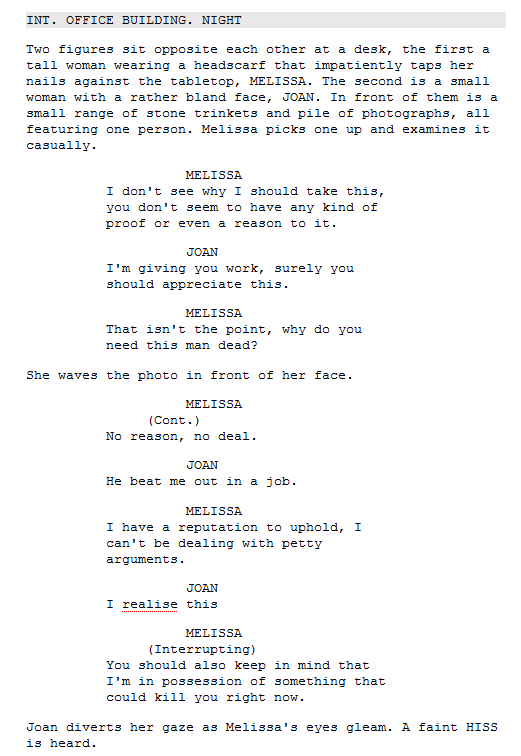
The film opens in a dark room, set up like an office. MELISSA, a modern day assassin is speaking to a woman, JOAN, about their work. They identify their next target as PERCY and Melissa sets out to find him. 
Pretending to be a interviewer, Melissa arranges a meeting with him. When he arrives,  Melissa is disappointed to find that he constantly wears a pair of dark sunglasses meaning there is no way for her to 'kill' him with her stare. The scene is a constant battle of her trying to get him to remove his sunglasses. throughout all of this, Percy believes she is flirting and asks her on a date.

Act 2 

During the date, the same problem occurs. Eventually, he does take off his glasses, revealing he is blind in one eye. Melissa takes this as her chance to petrify him, but doesn't realise that one of his eyes is Glass. The reflection of herself from the glass eye rebounds her stare, ending with her petrifying herself. Percy, panicking, calls Joan. 

Act 3
Joan receives Percy's phonecall, and acts shocked, saying she'll come and investigate. She then crosses Melissa's name off a list before calling another number and acting the same way she did in the first scene. Implying that Joan is actually trying to seek out assassins. 

There are three lead characters in this film:
Melissa: A paid assassin with a hidden identity . Would be described as anger prone and intimidating. 
Percy: A man with poor eyesight that's seen as a clueless but likable character. 
Joan: A suspicious older woman who hires Melissa


The themes in it would be not trusting people's appearences, this is shown in various ways.

Melissa is much more unusual than she seems, with the hints towards Medusa and her career.
Melissa believes Percy is wearing the glasses all the time just to be 'different' when in reality he uses them to hide something about himself.
And Joan is seen as harmless and needing help while she is pushing all the events forwards.


There are three main locations in the screenplay, all of which set the tone of the scene.

Melissa's office: This is where the dark part of the story begins, with two characters discussing the other. It's a very dark and modern place, with references to the original myth scattered around.

Percy's Office: An old fashioned place, made to be airy and comfortable, the complete opposite to Melissa's, this is where the two characters meet.

The park: The pretty nighttime setting of a local park contrasts the harsh fight, once again highlighting the differences between Melissa and Percy.