There are many different ways a project can be created and distributed to a company, Briefs, commissions and Tenders are good examples. A brief is an outline of project created by the client, providing guidelines for the creators to follow, a commission is when a client approaches a specific company or person with their brief and a
Tender refers to the process in which clients accepts bids or offers for a project.
There are also instances where the person doesn't interact with the company unless their pitch is accepted. Competitions, for example, where a company sets a brief to the public and accepts all entered responses, choosing one winner (or many) and providing prizes. The E4 was a competition, where the winner won money and had their video displayed on the website and channel.
In the E4 brief, we had guidelines that had to be met. The music had to be one of the tracks provided on the website, it had to be no longer than 10 seconds and it had to be a quality that could be broadcast on television.
The brief was to create a E-Sting with these guidelines and, because we were working on another unit, it needed to be a Stop Motion animation. There wasn't any specification on what it needed to be about though, so there was a large amount of freedom with the ideas people came up with and what kind of animation was used. In the media industry, the degree of discretion would depend entirely on the people involved, some companies may be very relaxed and some may have specific structures. When working to a brief there can often be changes made to the contract, even during the process of working on the project. There can be changes to budget, fees or conditions. This may be due to timing, if a project is taking more or less time than expected. Or if the company realises more work needs to be done than they initially expected. It may also be due to directors changing midway. Marvel's Antman had this, where it was initially directed by Edgar Wright who dropped out in the middle of the process when he felt that his work wouldn't fit in with the overarching plot between the franchise. This will have ended up with lots of changes made to the brief and film to fit the new directors.
The brief for this project was given by our tutor and the guidelines were on the website, this meant that we could check with them or on there if we needed more information. As the only specifications were to have a 10 second stop motion video for the e sting. The plot, style and idea were all entirely open. One thing we had to pay attention to was legal constraints such as Copyright, making sure that our idea didn't go against this or copy any ideas. Ethical constraints ensured that nobody would make anything that could be seen as rude or offensive. Regulatory means we had to follow the OFCOM rules. As we had followed the rules, there was no need for changes to be made to the work.
We created our first version of it and showed this to our tutor, who gave feedback of what we could alter. Such as creating the border from fabric. Then when we had a full finished version it was uploaded onto Youtube and feedback was obtained from the class.
Sometimes changes need to be made to a film so that it fits the age rating that the brief specified. An example of this is The Hunger Games, The company was aiming for a 12A film in the original brief but was told that, due to the large focus on violence in the film, the lowest rating it could receive was a 15. So after cutting a few shots and darkening scenes to make injuries and violence less prominent, which added up to around 20 seconds of cut footage, they achieved a 12A.
Someone may respond to a brief to earn money, showcase their work and build a portfolio that will then give them opportunities to get bigger projects There were many times in this project where I had to learn new skills because the task was so different to other work I'd done. I hadn't worked with stop motion, so this was a new skill that I needed to learn. It required a lot more time to do shots but everything had to be kept consistent so it was better to film everything quickly. So I had to work out how to find a balance of quality shots and a good use of time. I also hadn't worked with the Green screen, so creating the border was something entirely new. This also meant I had to learn how to use new tools on the editing software, such as how to remove backgrounds and improving colours. Because our work was only completed by two people, we both had multiple roles to fulfill. I ended up working on aspects of pre production, filming and editing. This included creating the storyboards, moving the stop motion objects and changing the colours of the video to make it more vibrant.
I have chosen to evaluate my work through a written review as it allows me to provide visual aids such as screen caps and survey result graphs.
I exhibited my work on a number of platforms, the first being YouTube as this is where the competition asks for videos to be posted. I then created a survey asking questions about it and posted it with the link to the video on on social media websites such as Facebook.
In our E Sting, there were regulatory issues in that the competition there is a specific set of music that needs to be used, so this limited creative ideas as we couldn't select our own one and it was difficult finding one that fit the video.
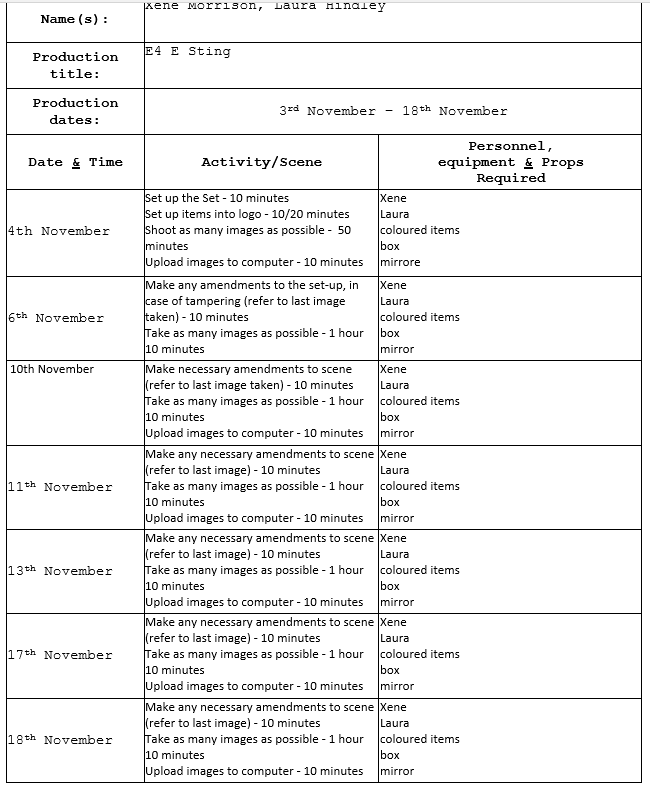
It was difficult to film it over a number of lessons, as the last shot always had to be set up in exactly the same way, so if the lighting or set had been altered we had to re shoot a lot of the frames.
3.Did you meet the requirements of the brief’s content? For example, did you conform to the guidance set-up on the E4 E Sting competition’s website? We met all of the guidelines, the full video on YouTube is 10 seconds long and all the sounds have been obtained from the website.
I created a survey for the animation which asked questions about the visual aspects of it, and also found out what the best parts of the video was and what could be improved.
A large percentage of the people surveyed are usual viewers of E4, so I know that the results will be helpful.
The survey asked respondents to rank aspects of the animation on a scale. The idea got the most praise, with all results being 'good' or 'excellent'. The others all vary in results, most are positive and there are none that have more than one answer as bad or awful.
They also said that the best part was the animation of the items leaving the box, but one part that could be improved was the ending as the logo was hard to see. So if I were to redo this, I'd probably have the actual E4 logo come onto the screen at the end, overlaying the one created.
Since I uploaded the video to YouTube, We were able to get feedback from the comments that members of the class had posted. Most of them talk about the camera movement being improved and the ending being clearer. The camera steadiness was directly due to filming over multiple days as the light was shifted slightly and made some of the cuts look jumpy. We could have fixed this by filming somewhere with artificial light rather than an area with windows.
I have learnt that having to do work that takes a long period of time means that it's more difficult to get people involved. Our original idea was to have people moving into the logo but this was restricted as the work had to be filmed over a specific area of time, and we weren't able to get enough people who were consistently free at the times.
I feel like I would be a suitable candidate for work within the media industry where working to a brief is commonplace. I have finished my work quite far before the deadline and think that it fits the standard of E Stings. Though I personally don't enjoy working in stop motion as it takes long amounts of time and there's a large chance of it going wrong.
When creating the E Sting, there are several competition rules that apply to it.
The video must be 10 seconds long
The music used on it must be one of the tracks provided by the competition, no commercial or copyrighted music can be used.
You must have a YouTube and Twitter account
My own idea involves a blank sheet of paper, with someone moving their hands around to create a drawing on it. This would be done with live action stop motion with each shot showing a different part of the drawing.
The idea that I am working on is also live action animation, the concept being a large E4 logo created in a hall, with people in coloured clothing on the floor to create it. As each shot is taken, more people will be added to the picture so that by the end it looks correct.
The animation will need to be set in a large blank space that have the outline of the logo on the floor. This would be set in a sports hall, as this is a large space with enough room for the people as well as a balcony to take the photos from.
The difficulty we face is trying to organise such a large number of people, as it increases the chance of something going wrong either in the stop motion or to someone involved. . We're also limited to which location we can shoot in because there needs to be somewhere that we can get the bird's eye view shots.
It's likely that this is an impossible task due to a lack of people, so an alternative to this would be to have a jewelry box full of items such as fabric and makeup which move around to form the logo.
The primary target audience would probably be female teenagers, as we're filming inside somewhere that is obviously a sports hall. They will also appreciate the use of stop motion more than younger viewers would. The secondary audience, looking at the channel data, would be male teenagers as this is a large percentage of E4 viewers.
Props needed (Purple and White mixture)
·Hairbrush
·Nail polish
·Fabric
·String and yarn
·Makeup
·Headbands
·Hair ties and scrunchies
·Other objects that would typically be found on a
girl’s desk
E4 is the channel that began back in 2001, originally showing reruns of shows from other channels and airing American programmes.
It now runs it's own British TV shows such as The Inbetweeners and Hollyoaks, while also still airing American sitcoms like The Big Bang Theory and Friends. The primary Target audience is older teenagers, there are shows that you appeal to more than one gender, but the majority of shows seem to be male targeted. The secondary audience would be Teenager girls, older men and women. The audience are likely to be main streamers. This can be seen in the style of the shows which do the best in viewing figures, which are usually comedies.
A graph showing the most popular episodes
In terms of regionality, the main viewers will be British, as this is where the channel and a majority of it's shows are created, and in terms of class in would probably be lower middle class/ Skilled working class.
It is a companion to Channel 4, and is owned by the same company. It was made as a entertainment based alternative that was originally a paid added channel but eventually moved to being a part of various TV subscriptions such as Sky. Channel 4 also owns More 4 and Film four.
E4 uses 'E-Stings' in between their programming, these are short ten seconds videos that show the logo in a funny or clever way. They hold competitions to give people a chance to send in new ones. My brief is to create one of these using stop motion animation.
Entries on the website
There are several E Stings that have been created that I find interesting or funny, for a variety of reasons.
This one is titled 'Flavour of Life' by Veronique Lacloche on YouTube , I like this because of the well known content in it, using a 'Great British Bake off' style short, a show that people are familiar with. I also like the use of hand drawn animation as it makes it sweet and nice to watch. The genre for this is comedy, shown with the colorful drawings and funny content with the 'flavour'. I think this target audience would be young adults as it would need to be people who recognise the show but still appreciate the childish art style.
The second one I liked was 'Hero' by Elliot Ames. I like this one because of the soundtrack and simple use of shapes to create the characters. The theme of this would be action, as it shows the typical ideas of superheroes. The target audience would be teenagers as it has reference to comic characters such as Batman or Superman.
This is an unnamed E Sting created by Will All. I chose this one due to the unusual style, using animated paper cut outs. This one would have a target audience of older adults, as they would appreciate the technique more.
To respond to his brief of creating an E Sting, I first researched old fashioned animation and created samples.
For the next part of the research we worked with Lego, I created a small dragon and filmed it breathing fire by adding more blocks in each scene. Lego is a good tool to use as it looks clean and is easy to use. It is also easy to keep models upright due to the nature of the product, while materials such as puppets may be difficult to animate. The downsides to it is copyright, as Lego is a large company, and a lack of movement in the models. This means that some of the shots look bulky or strange. This could be good to work with for my final piece but, due to the copyright on the product, I'd need to find a different version.
There are many different kind of animation based toys, the first being the thaumatrope. This is a piece of card with an image on both sides and a piece of string on the edges. The toy is spun using the strings, displaying the images on either side. This gives the impression that both images are merged, due to persistence of vision.
For mine, I drew a dancer and a stage, so when the toy is spun, it looks as if she is performing. I feel like this one went well.
A Zoetrope is a small circle of plastic with raised sides, like a wheel. These sides have slits in them. An image is create on a long strip of paper, with around 8 small images all displaying one ongoing action. When they're spun in this toy it looks like one perpetual motion. This is why the images must loop back round, with the last following into the first. It's similar to a modern day GIF file.
For mine, I drew a person having an idea and then losing it, so when it is played together it looks like he's thinking. My only problem with this one is that the person does not look exactly accurate every time, as I didn't fully plan out each slide.
A Praxinoscope is similar to a zoetrope, but is a spinning wheel with mirrors. The image strip is placed onto the base and is reflected in the mirrors. This again gives the idea that they are moving as, when it spins, the mirror stays in one place displaying the pictures.
For mine, I drew someone with a hula hoop. This worked well, but didn't perfectly loop back as it should have done.
The explanation behind all of these is 'The Persistence of Vision', this relates to a theory about how our eyes remember images for a few seconds after we've seen them. This explains how these toys work, as our vision will 'remember' the first image as it sees the next, and will mistake them as being together.
There are many pioneers of Stop motion animation, both old fashioned and modern.
Aardman, the company behind Wallace and Gromit, work particularly with Plasticine based models, Their work focuses mainly on the way their characters are animated.
PIONEERS OF ANIMATION
George Pal worked with puppets and time lapses, creating short films that were . He is behind the films 'The Time Machine' and 'The War of the Worlds'.
This clip shows the time lapse photography and stop motion used in the Time travel scene.
Ray Harryhausen found his fame in creating prehistoric films and the research of Dynamation. His most famous film was 'Jason and the Argonauts', which featured early stop motion footage of a variety of creatures made from clay, such as skeletons and a moving statue.
Phil Tippet specialises in Stop motion and visual effects, he worked on many of the scenes in Jurassic Park and the Star Wars films
Tim Burton and Henry Sellick work using very detailed puppets and small models. they are well known for their abstract and usually creepy style of film. Most famously, they created 'The Nightmare before Christmas' which was entirely stop motion.
Adam Shaheen is the founder and executive producer for Cuppa Coffee, working on over 200 adverts.
The brothers Quay create their film using inorganic items such as dolls or screws, using disassembled and rearranged. The style of their films is unusual and relies heavily on music without much dialogue.
There are several children's TV shows that use stop motion animation, with a variety of different types. One that is very well known is Postman Pat, which has been around since 1981. It uses small models with realistic hair and clothing in a colourful 3D setting.
A more adult take on Stop Motion animation is Wallace and Gromit, created by the Aardman company, which is noticeable by it's rougher designs and the fact that immense detail is paid to background and small movement such as eyes.
Paranorman is a more recent example of a stop motion children's film .I've chosen this example of this style as. although this film has a much more mature theme behind it, it did very well amongst younger audiences and featured themes relating heavily to school life.
In the Star Wars Films, a small amount of the battle scenes in the Empire Strikes back were animated using Stop Motion. Most noticeably the AT-AT's in the Hoth Battle.
These were adverts created by the Aardman company, featuring small plasticine people to show ideas about fitness and healthy eating.
Creature Comforts was a series of adverts that aimed to teach lessons about safety or insurance. It features model animals and contains strong voice acting to bring in the humour.
In the Spice Girls Music Video 'Viva Forever' there is a section which features fairy like versions of the band members. These were small models created from tin and the short section took months to make.